What its all about...

As a fan of table top Role Playing Games, and Video Games, not to mention anime I once had a web site that I devoted to creating conversions of the things I liked to a particular game system or another.

Well I'm back and its time to get back to posting and talking about the things I like with others.

Video Games: I will be trying to write reviews for games I play and may even work out conversions of games to table top RPG's for gamers to enjoy, or at least I will give a guiding hand rather than doing all the work myself. Unfortunately the only game system I own is an X-Box 360, and my computer which kind of limits what I can do. Unless some kind soul wants to buy me an X-Box One. :)

Table Top RPG's: I play a few different table top games along with my friends. Sometimes I will write about a game system I have read up on or tried out, and may write up a conversion for agame system. Game systems I typically play are - Hero System (Champions, Fantasy Hero); Star Wars (Fantasy Flight Version, Saga Edition); Savage Worlds, D&D (3.5 Edition, 5th Edition); Pathfinder, and possibly others in the future.

But I look forward to providing folks with some entertainment and to get some discussions going on things I may post (but please keep it civil).

Also please feel free to click on any ads that are on my blog here, doing so really helps me out.

Sunday, September 2, 2018

Pathfinder 2nd Edition, Rulebook Assessment

Image result for pathfinder 2.0


As many people know, Pathfinder has finally gotten around to creating the first revision to their rules.  Pathfinder 2.0 now has a playtest rule set out now, and I’m going to go through the rule book and make my own assessments of what’s there.  To start, I will not be assessing the “overview” of the book too much, rather I’ll only focus my attention on the aspects that deal with character creation from there, though I may backtrack if needed as I get to new chapters/sections.


Image result for pathfinder 2.0Abilities & Generating Scores
The classic six have returned.  To be honest it would have been nice to see a bit of a change up to further differentiate itself from D&D, but when something works you may as well stick with it.
Ability scores start with a base of 10, from there you apply what they are calling Ability Boosts and Flaws.  A boost will typically add up to 2 points to a score, but if a score is at 18 then it can only be increased by 1 point.  And at 1st level the highest starting score you can have is 18.

This isn’t too surprising as D&D 5th Edition even puts a limit on how high your starting Ability Score can be.  What confuses me is if you have 2 points that would go to a single score if it automatically equates to just a +1 to it if your at 18 or higher.  If I were to guess, I’d say yes.  Now Ability Boosts break down into ones that must go to a specific Ability Score, and “Free” points that can go anywhere.

At every 5 levels (5, 10, 15, 20) you gain ability boosts in four different scores, and your free to apply these points to scores that are at 18 or higher.  Just remember that if a score is at 18, it will likely cost you 2 points to up it by just 1 point.

Now Flaws come in as the opposite of a Boost, decreasing a score by 2 points.  These are not common placed, and typically result from a character’s ancestry (discussed soon).

Over all it feels like a refinement of the Point Buy system, and integrates it completely into character creation.  Your character’s Ancestry, Background, and Class are the aspects that add to your starting scores.

But what if your dead set on rolling dice?  Well there’s rules for that still.  Yep you’re not forgotten in there for those groups that prefer the total randomness of dice rolls.  Here the base generation of scores is partly ignored and the classic rolling of 4d6 six times and discarding the lowest die is used.  Of course, the score limit of 18 is still applied.

From there you apply bonuses from your Ancestry, Background, but not one from your chosen class.


Related imageAncestry, A Nice Way of Saying Pick Your Race/Species
The first thing to keep in mind here is to only expect the basic character species, and nothing too exotic.  Here you’ll encounter the Dwarf, Elf, Gnome, Goblin, Halfling, and Human.  Half-breed species are handled in a unique way.  Here you start with a base human, and then select an appropriate “ancestry” feat that you will apply to the character.  Its an interesting method of dealing with it and could allow your to work out a character who is made up of 3 different species…well that is how it initially reads, since this is just a side bar. We’ll see how this plays out once I get around to the human.

Now each species does have a level limit, and as you gain levels you can gain additional Ancestry or Heritage feats.  That is to say; some feats have the Heritage trait and can only be taken at 1st level.
Character species all determine your base HP, grant Ability Boosts/Flaws, Size, Speed, Languages & bonus languages, Traits, and special features like Darkvision.

Dwarf:  Seem pretty light, when you look over their Ancestry feats.  It feels like they should get to pick two of these at the start, but you get just the one.  Dwarf’s start with 2 inherent features. And an ability flaw toward Charisma.  Dwarves start with a base HP of 10.

Elf:  The elf seems pretty straight forward, one inherent feature and an ability flaw toward Constitution.  Compared to the Dwarf they should have one additional feature, but don’t.  Elves start with a base HP of 6.

Gnome:  It’s a bit funny to see that the gnome starts with 8 HP, more than the elf.  Like the elf, they have only 1 feature, and their ability flaw is toward Strength.

Goblin:  Well here is the hallmark of Pathfinder.  Goblins get one feature, 6 HP, and Wisdom as their flaw.

Halfling:  So for the halfling your looking at no features here.  Now its possible that they may be looking to add something later, but the species feels its severely lacking in comparison to the other species on the outset.  Starting HP is 6, flaw is Strength, and no, they don’t get any extra feats.

Human:  And now to see what the Human species has to offer.  Starting HP is 8, no flaws since you can choose 2 boosts to apply freely.  No features are present, and humans only get the one ancestry feat.  Now half-breed species are outlined here, and it looks like there’s no mixing & matching.

Backgrounds
Following the various species or Ancestries, are backgrounds.  These seem to be similar to the backgrounds found in D&D in terms of names. Each background offers 2 ability boosts, with one on a required ability score, and the other being a free boost.  Your character also acquires a skill feat of some sort that pertains to the background, as well as being trained in a similarly appropriate skill.  This feels to be the same as that what we’ve seen in D&D 5th Edition, but with its own spin on things.

Languages
Well nothing really spectacular or different here, just the usual list of languages and what speaks them.  Moving on…


Related imageClasses
Finally, the bread & butter of the game.  What we have here is the usual assortment of classes…but with the exception of the loss of the Warlock class.  Each class has a key ability that you need to be the focus of your ability score building efforts.  Hit points that they gain, proficiencies, a specific skill that their trained in, their saving throws (which are noted as Expert or Trained), a number of skills that they are trained in as well, and finally something called Signature Skills (which seem to be specific skills that can be increased up to certain high levels that others cannot, if I’m reading into this right). 

Additionally each class has specific class feats available to it, and those feats are listed with the class, making it easy to find them instead of searching through a list and then looking at the writeups in a different chapter.  Now please keep in mind that I’m not going to write out every aspect of a class, but I will hit on a few points.

Alchemist
I’ve never played an alchemist in any game.  Now with that in mind, the alchemist is all about bombs and potions.  INT is the main ability score, and HP is 8 + CON.  Perception is at the trained level of the class.

Barbarian
Well this seems to be your normal rage monster.  Barbarians make use of totems and their rage in combat.  The totems here are Animal and Dragon, Fury, Giant, Spirit, and Superstition totems.  Unlike Barbarians in D&D, the ones here need armor, not just a CON modifier to use for your AC.  Key ability is STR of course, HP is 12 + CON, and their Perception skill is at expert.

Bard
Well here’s the class people largely think is annoying and useless.  The Bard is the start of the spell casting classes.  Cantrips here do follow the D&D route of cantrips not using spell slots and can be cast with impunity (so to speak).  Bards has muses that help to influence their performances.  Spell casting makes use of something new (but not really) called spell points.  Key ability is CHA, HP is 8 + Con, Perception is Expert, and I will mention they have 7 signature skills.

Cleric
Our next spell casting class.  Clerics introduce Anathema which is something that a character can do that will cause them to fall out of grace with their deity.  They also get a Channel Energy pool that is used to cast either positive or negative energy spells (this is based off your deity).  The energy in the pool is used to cast either Heal or Harm spells.  Key ability score is WIS, HP is 8 + CON, Perception is trained.  They also have a decent number of skills.

Druid
Pretty much what I’ve been expecting after seeing the Cleric.  They also have an Anathema, and the Druidic Order feature which grants several benefits.  The Orders available are Animal, Leaf, Storm, and Wild.  Key ability score is WIS, HP is 8 + CON, Perception is trained. 

Fighter
Ah the bread and butter of any adventuring group.  The Fighter is fairly straightforward and flexible in how you would expect them to be.  Key ability score is either STR or DEX, HP is 10 + CON, Perception is expert. 

Monk
Now my only problem with monks in all game systems is that you never have the option of being a monk, or a martial artist, or a mystic warrior (ala Street Fighter). Its one of the reasons why I make my own martial artist class.  Well this one moves a bit more in that direction, thankfully.   Key ability score is either STR or DEX, HP is 10 + CON, Perception is trained.

Paladin
One of the classes I don’t typically play (if ever).  Paladins no longer cast spells, instead they just have an array of powers that make use of the new spell point system for their powers.  Paladins are expected to be lawful in the rules, based on how I’m reading things, but it seems that there is room to allow for a Paladin to be any alignment, so long as the GM & the Player can set up some sort of code for them.  Key ability score is either STR, HP is 10 + CON, Perception is trained.

Ranger
The ranger in this game isn’t some fighter & paladin mix but is a hunter & tracker to the core.  Don’t expect some magic, just what you may expect from someone who hunts creatures.  Key ability score is DEX, HP is 10 + CON, Perception is expert.

Rogue
First off, don’t worry, the sneak attack feature that has been classically found in the Rogue class is present.   But what more is there to say? Rogues are still the tricksters and thieves that they are in D&D.  Key ability score is DEX, HP is 8 + CON, Perception is expert, and rogues have the most in the ways of skills than other classes.
  
Sorcerer
And here we are with the next major spell casting class.  Like in previous editions, bloodlines play a part in figuring out spells/powers associated with the bloodline.  And as one would expect, the class feats mostly pertain to enhancing spells.  Key ability score is either CHA, HP is 6 + CON, Perception is trained.

Wizard
The companion to the Sorcerer class.  Wizards appear to be very much the same as well.  You focus on a school of magic and that helps to influence your spells.  Key ability score is INT, HP is 6 + CON, Perception is trained.

I will add that at this time there is nothing present on multiclassing in the class section of the book, but this may be covered later.


Skills
As one can expect there will be a large array of skills by which the character uses to complete tasks.  What is mainly of note here will the how you figure out your “Total Skill Roll Modifier”.

This formula is:
Ability Mod + Prof. Mod + Circumstance Bonus + Conditional Bonus + Item Bonus + Any applicable Penalties (there’s about 4 noted sources present)

Frankly this is a bit much and can due with being simplified like how D&D deals with things.  One irritation I have with he onset of this section is there being no reiterating explanation on the proficiency levels (untrained, trained, expert, master, legendary).  This is only commented on back at the start of the book under Proficiency Modifier.  But this allows me to go back and cover that now in relation to skills.
  • Untrained:  Equal to your Level -2.
  • Trained:  Equal to your Level.
  • Expert:  Equal to your Level +1.
  • Master:  Equal to your Level +2.
  • Legendary:  Equal to your Level +3.

Now each of the noted bonuses is a single static bonus and does not add onto what you have from previous proficiency levels.  Thus, if you have Acrobatics at Expert, at level 4, you would add a +5 bonus to your rolls.  But if for some reason that proficiency went up to Legendary then your roll would be +7.  Now just add in your Ability score modifier, and all the other trimmings and your set for a skill roll.


Feats
What’s a D&D game or in the case of Pathfinder, a D&D derived game, without the appearance of feats.  Feats in this section are set up as Non-Skill Feats, Varying Skill Feats, and Specific Skill Feats (namely they apply to a specific skill like Acrobatics, or Crafting).

Related imageEquipment
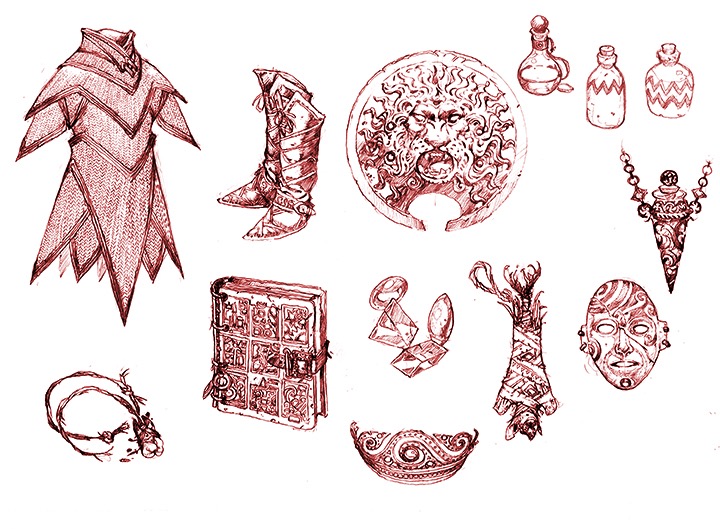
This section of course covers all the trappings your would-be hero needs on their adventures.  Currency, coin bulk, pricing and so forth.  Weight in this revised system uses bulk, much like Starfinder.

Your limit in Bulk that your character can carry is equal to 5 + your STR modifier with out penalty.  Carrying more than this will encumber your character, and you are limited to a maximum of 10 + your STR modifier.  And being encumbered means that your speed is reduced by 10ft (to a minimum of 5ft).  Armor check penalties also increase when encumbered.

Combat actions are covered here as well with your weapons, and amazingly enough they do cover using a shield as an improvised weapon.

Attack rolls work about the same.

Multiple Attacks work like this, a second attack is at a -5 penalty, and any subsequent attacks take a -10 penalty.  This doesn’t count toward attacks that you may take that are not on your turn.
Critical hits work about the same, though they also add that if your attack roll exceeds a target’s AC value by 10, it counts as a critical hit as well.
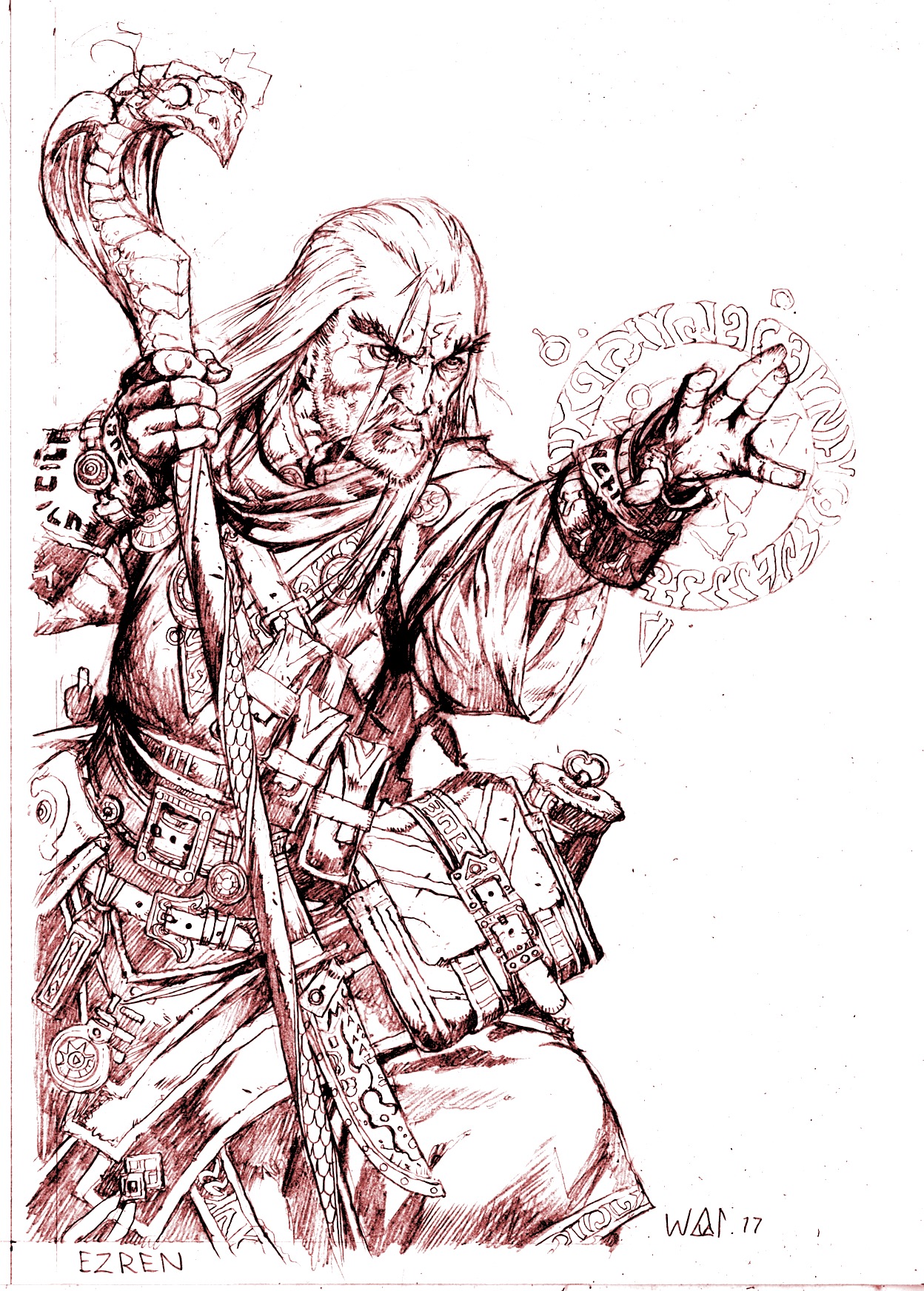

Image result for pathfinder 2.0 wizardSpells
Well where would we be without magic.  One interesting inclusion are certain superscripts after a spells name (H, U, R).  Spells themselves range from cantrips up to powerful level 10 spells.
  • “H” means that the spell has stronger effects when heightened.
  • “U” means that the spell is of an uncommon rarity.
  • “R” means that the spell is rare.

What “U & R” mean for a character is that you character just isn’t going to be allowed to have them unless the GM allows you to have access to the spell.  Thus, spells that could shape the fabric of reality are not just something you get to pick out of the book to know – you very well may have to earn the spell.


Advancement & Options
Well here is the portion that outlines how your character advances.  One big change is that to go up just 1 level you need 1,000 xp.  Anything left over carries over toward the next level.  Obviously, your current level and such will impact how much xp you get from encounters.

So when you go up a level your HP increases by an amount noted for the class (thus a fighter gains 10 + their CON mod per level.  You gain a noted class feature, feats, any new spells, and adjust your proficiency bonus.

An option for character advancement are Archetypes.  Applying an archetype has you spending a class feat(s) on an Archetype feat(s) instead.  One of these is, indeed, a Multiclass archetype.  The other type of archetype are Prestige archetypes.

Animal companions and Familiars are covered here as well.  Deities are here as well and that is it.


Playing the Game
The next section covers aspects of game play.  A reiteration of some rules from earlier are found here in some tables.  No point in hitting on every little thing here, its how the games played, so you’ll want to read the rules yourself.  What’s also helpful are the diagrams for the different shapes of attacks like cones, lines, and the inclusion of aura’s and burst effects.  Making a return are Hero Points.  You can have up to a max of 3 of these and there are three specific uses for these.  These are rewarded by doing heroic deeds or tasks, or when you do something special.  Of course, once a game session ends these points go away.

Personally, I prefer what D&D does with Inspiration.

The main part that is stupid and makes no sense is the rules for “Grid Movement”, moving diagonally will cost you a different amount of movement.  For example, like the use in the book, your first diagonal movement costs you just 5ft, but if you move diagonally again it will cost you 10.  Frankly this doesn’t make sense as the map distance is technically the same.  This rule feels unnecessary and bogs a game down with an unneeded rule.


Game Mastering
The GM section is next up a goes over everything you expect the section to have.


Treasure
Well every adventure needs rewards beyond just getting xp, and this is the section that outlines that.  Not just treasure that can be found, but rules for crafting with special materials are here as well.  A special item of notice with weapons is that if it’s, for example, a +2 Longsword you add a +2 to your attack rolls, but you also that +2 also means that if your attack hits you get to add an additional 2 dice of the weapons damage to what is dealt – thus you roll 3d8.


Following all this is the Appendices and Backmatter (where you will find the character sheet).


Assessment
Over all these are some interesting rules, and they do seem to take some notes from D&D 5th Edition and Starfinder, while at the same time also being different from either system.  Character species/ancestries are too light at the moment and need to be better rounded out.  Character species in other games offer much more from the get go, while these go for an enhancement over time deal, which is ok, but the initial offerings at level one need to be just a bit better.  Also, the species that are missing some stuff need to have all that filled in more.

 I like the idea of how the classes work, allowing players to have more freedom to pick and choose how they want to grow their character for that level.

Movement rules using a map are too complicated.

Over all rules feel too complex in general, still too crunchy.  Frankly one of the things that most people I’ve talked to about Pathfinder hate is how crunchy the rules are.  These rules, while a bit better, do need to be toned down a bit.  Its part of the appeal of the advantage/disadvantage system that D&D uses.  In fact, with Starfinder I’d incorporate that rule in place of some other rules present.

One of the things that I like about D&D 5th Edition is that its simple and quick to pick up and play.  A little complexity is ok, but I feel that Pathfinder 2nd Edition needs just a little more toning down on its complexity.

But, this is why there’s playtesting and reviewing.  The game can only get better if folks put forth their thoughts on matters to help make it better.

Either way I suggest everyone give it a try and let the folks at Paizo know just what works and what needs improving.


Tuesday, July 31, 2018

A Discworld Inspired Starfinder Adventure

Well here I am again at the end of the month with a new post.  As I mentioned before, I've been listening to all of the Discworld novels and some changes are made to the Starfinder game setting to accommodate an alteration to make the setting a bit more like that of the discworld.  To get up to speed for this, I suggest you take sometime to familiarize yourself with the Discworld, then get started with a game.


--On the Setting--
Note to GM’s…Absolom Station in this setting is much bigger than it is normally.  It is essentially an artificial planet that was made to replace the one that went missing.  The station is roughly over 2,000 miles across.  Its exterior sections comprise the industrial workings of the station that allow it to function/operate and thus maintain the atmosphere of the encased chunk of planet.

It is believed and to a degree known that the section of planet may have been a part of the skull of a god that died who knows how many centuries ago.  Natural resources are present (for example, gold was believed to have been a part of its nervous system, and magma – such as what it is – is believed to have been blood that is still circulating).  The main reason for the belief that this was part of a god are the deposits of fat that can be mined.

There are a number of regions, as well as there being an ocean.  The central and largest city of the station/planet is the city Star-Morbief.  An academy of magic is present here, along with many different guilds which more or less run the city as its council…with one small exception.  The city is essentially governed by one person, the Regent.

Running a massive city is a difficult thing, more so when the city is the central hub of the station.  The Regent is often viewed as an evil man, but this is only do to the fact that in order to keep everyone in line you had to be quite the prick when no one else wanted you to.  He also has a practical view toward crime, namely that since there is going to be crime, it best be organized under the rule of order.  Thus, there are many guilds that exist in the city as a means of controlling crime.  It all works oddly enough.

For example, for a small monthly fee people can avoid being mugged or robbed.  There is a guild for almost everything in Star-Morbief.

While the Regent controls the city, it is the Overseer that manages the entire station.  She ensures that everything works and stays working.  The Regents of the cities all answer to her, though her job is typically busy enough as is that she has time to deal with the Regents.  She gets reports, and typically is quite happy with the work of the Regent of Star-Morbief (who is an impossibly clever man who seems to know that is going on in the city even when magic is being used to obscure scrying).
Since the station possesses an atmospheric shield, ships can land directly on the surface instead of in any of the outer landing bays.  This is widely frowned upon, and the regents of the various major cities and the outlaying governors & mayors take a hard edge against space vehicles landing on planet with out the proper authorization (often requiring the direct authorization of a person in charge of the surrounding area or getting authorization from the Overseer’s office.

The station is a bit of an oddity.  Aside from believing that the land was once part of a god, the station appearing in the place of the planet Golarian and possessing the Starstone (which powers the whole thing and keeps the land alive), it also has roving dungeons which appear in the land for no real reason other than to provide starfinders with a challenge every once in a while, and to spew out monsters.

Additionally, there is the high magical field of the place which causes certain things to manifest an avatar of what they are.  Not everyone can see these avatars unless they possess magical capabilities or are under particular conditions that would allow them to.  For example, Death is manifested as a skeletal man with a scythe who rides upon a pure white horse.  Magic users can see Death for what he is when he is around, while other beings either won’t see him at all or their minds will simply insert a different visage of what they are seeing instead of what is really there.  The only other way that Death is visible to normal people (or non-magical folk) is by either being a child, a cat, or being in a heightened state of awareness where death is ever close at hand.  Death is not evil, and there is a death on every planet, tending to just that planet.  The Death of Golarian is the Death of the station.  He knows what happened to the planet, but it is not his place to tell people what really happened, it would be against the rules.  And while he may bend the rules, he does not break them.  Death cannot be compelled to divulge the truth of this, and even gods are subject to him when their time comes.  Death is always polite and finds mortals interesting.  However, Death sometimes becomes depressed and wanders off from the job, (but never for too long).  He has a love for cats and can become irritated by people who are cruel toward them.

--Oddities of the World--
The world that is the space station is filled with various oddities.  Some gods live upon the world, off and on, and a there is a Death that cares for the dead of this place.  The players encountering death during life or death circumstances should provide brief light-hearted moments, where time seems to stop, and they get a bit of a parlay with Death.  These are brief moments meant to allow a Level 1 character to survive.  The player to get to abuse the stop in time for a moment (one free turn of actions).  They can hold a conversation with Death who is accommodating but must let time progress normally at a point.  He won’t care too much for the abuse of things – all things die eventually, but he would prefer if people would stop taking advantage of these little interactions.
Dungeons don’t often appear in cities, but when one does its never a good thing.  While smaller than those found outside, the monsters inside are exceptionally dangerous and they don’t typically stay confined.  The city police often can keep these occurrences confined, but outside help is never turned away.

There is also something that grows on the land here called Sapient Pear Wood.  It is magical, though its true properties aren’t revealed until you make something with it.  Staves and wands are the most common things made, but people have also been known to make chests and trunks out of the stuff.  Its virtually indestructible (has a lot of HP and DR), will follow its owner anywhere (somehow), and seems to have its own personality.  It acts in a similar capacity as a bag of holding, save that it’s as if it has several bags of holding…as well as being able to act like a mimic in that it will eat beings that cross it.

Wands & Staves made from the stuff are semi intelligent and won’t allow any other magic user to use them except for their owner (they are magic items, and grant the user the ability to use one or more magic feats in addition to what the user already knows.  The wand or staff will also teleport to its owner when called.  Armor and weapons are not typically made out of the stuff due to the difficulties in working with the wood, though if a weapon has a portion of wood as part of it (like a hilt, or stalk) then the item will teleport when called coming to their hand.  Even though the wood could be sharpened to have an actual cutting edge, the problem there is that you could end up cutting your fingers off or impaling your hand.

Armor is no better either.  You could call on it, but it could manifest on you backwards, upside down, or even correctly.  But it also could appear inside you.  Luggage made of it though doesn’t have this property and is more sapient than items are.  Chests and similar objects made of the stuff get around on dozens or hundreds of little legs but can pass through dimensions and bash their way through walls, doors and the like with single minded purpose.  They can even travel in the void of space somehow, but it’s best not to think about how it happens.  Luckily few people want sapient pear wood things due to the problems involved with it.

--Character Creation--
Characters can be of any type from the PHB.  In terms of background, however, all PC’s are required to have a common desire to explore and understand the universe.  The PC’s are each a scholar in their own ways.  As such all PC’s are required to have at least 1 knowledge related skill (Culture, Life Science, Mysticism, Physical Sciences, or Profession).

--The Starting Adventure Hook--
The game starts with the PC’s on Absalom Station.  They have recently joined the Starfinder Society out of a curiosity to see the galaxy and understand it’s wonders.  The roving dungeons of the station are considered a good testing point for new Starfinders.  These dungeons often are an irritation when they appear around cities, but the further out that they appear, the more dangerous they become (typically).

As a test of their capabilities, the Players will be tasked with exploring a dungeon that has been annexed by the society on the outskirts of Star-Morbief.  It will be up to them to locate the dungeon, and then explore it.  If they meet any difficulties that exceed their level of capability they can either, choose to press on or raise the alarm to the test’s overseers.

The dungeon should be two levels and is meant to take PC’s from level 1 to level 2.  Encounter difficulties are meant to be “average”.  Make the encounters low tech for this dungeon if possible. Skeletal Undead are a good starting foe, as are Space Goblins (though they should be treated as just normal Goblins for this dungeon.

There is also a dungeon master, a monster that is essentially the final guardian of the secrets of the dungeon.  This should be a single creature that is a “Challenging” or “Hard” opponent for the entire group.

At the end of the dungeon is the riddle of 3 qualities.
  • Which is the greatest quality; Might, Intelligence, or Power?
o   The riddle must be answered by each person present, it must be their own answer.  When an answer is chosen, a door opens to admit one person at a time into the room beyond.  A magical force will keep anyone else from forcing their way in.
o   If answered wrong, after entering the door and it closes, the person finds themselves back at the entrance of the dungeon, and unable to enter again.
o   The answer is different for each person.  It is a riddle of self-value.  What does the person value most?  Strength has many meanings.  A character that enjoys exercise could see that valuing physical strength is most important to them.  But a strong moral compass may also be an acceptable answer.  Intelligence also has its meanings, is it over all intellect, or is it knowledge of a particular thing?  As for power, it should be self-explanatory, but power also has many meanings as well.  Is it the power to influence others, or magical power?
o   When answered correctly the door leads to another room.  A scroll is present.  When read, the magic vanishes but the words on the scroll remain, its language after this is indecipherable by the PC’s (DC 35-40 for an appropriate skill roll without the right tools, or time).  Players who chose Strength will gain a +1 to either STR, DEX, or CON (choose one to apply it to), or they can gain a combat related feat.  Those that chose Intellect can apply a +1 to either INT, WIS, or CHA, or they can gain a skill related feat.  For those that chose Power they may know 1 additional level 0 & 1 spell, or a feat that enhances magic or some other class ability.  With those that have no magical power they instead can choose to know a single level 0 spell (if a DC is needed for the spell then it is generated like it would be for any other class).

Once everyone has left the dungeon it vanishes, their Health is also restored upon leaving.

Awaiting everyone outside will be a small group of thugs.
[NOTE:  This group is present to help put PC’s up to level 2 if they are not already there.]

The thugs are there to take what ever riches the PC’s have found.  Its not an uncommon practice to do this, the Regent of the city does frown upon the practice when not done in the city and under the licensed supervision of the Thieves Guild.

Guilds
This city of Star-Morbief is home to a number of different guilds, and with a suitable petition and $2000 credits you can start your own guild as well.  While there are a number of guilds there are certain guilds that stand above the others.

The Thieves Guild – Since there is going to be crime, it may as well be organized.  For a small monthly payment, a citizen or visitor to the city can ensure that they are not mugged or robbed by one of the many licensed thieves of the city.  Killing by a licensed thief is prohibited, but accidents do happen.  On the other hand, an unlicensed thief does not want to be caught by the guild, especially if they want to keep all of their limbs intact.  People who want to steal and not pay guild dues typically work outside the city, but there’s still many people who are gutsy enough to work with in the city.

The Assassin’s Guild – While one would think that assassination is an underhanded profession, the assassin’s guild makes it look cool.  Aside from offering one the best educations money can buy; assassination work requires paperwork from clients and thus contracts to be set up and full filled.  The guild has the right to raise the payment for fulfilling contracts on certain people, as well as black listing possible targets.  Their job is largely seen as a public service since most people who can afford an assassin are those with wealth who by large see the work of offing a competitor or government lacky as a good service to them as they are a part of the public. 
They do travel, however, and thus typically operate outside of the cities confines.  Not all assassins survive the years of training, and some choose to quite with an excellent education under their belts.  Most law enforcement agencies in the galaxy know that once an assassin returns to the city, their off limits.  For the sake of decency, the guild is referred to as the Dark Scholar’s Guild, but everyone knows that it really is.  Assassin’s do work that doesn’t involve murder, often sending a very pointed message.

The Red Light Guild – If the name wasn’t obvious enough, the guild is one that women and men of “negotiable affections“ are members of.  The guild offers a high degree of safety for its members and of course offers them great healthcare.  Before new people can visit their chosen “date” they do have to undergo a health screening or provide current documents on one’s health.  Discretion is always apart of their business as well.

Other Guilds – For most major types of businesses, there is a guild.

Starfinder Society Guild – While the guild works largely the same as that of other guilds in the city, they are the only guild with noted operations across the galaxy.  In the city, and generally on the station, it is the job of the Starfinders to explore the dungeons that spring up.   The on-station work pays decently (free room & board at guild houses, + 1,000 credits a month {minus membership fees, with raises based upon activities and experience}, + the right to keep certain findings or have certain discoveries named after them {for good or bad}.

Once the players get back to the guild with their information, they are told that the guild’s experts will need 24hrs to decrypt the scrolls.  The magics had a purpose that was served, but the scrolls contain imbedded micro-circuitry in the paper in addition to the strange language on them.

The end of the game session is here.  There is a new adventure hook waiting that involves the scrolls if they want to pursue that, or they can choose to find something else to do.


Sunday, July 1, 2018

Project Update, and the wonderful world of the Discworld...

Hi everyone!

So work on a Starfinder campaign is a slow moving thing.  The trouble I'm having is two fold.

First, time, has not been on my side.  A new round of college has started, though this semester seems like it will be a bit easier to handle than last semester.  The previous semester of work was a lot of busy work, lots of coding, but lack of structure from the instructors.  They wanted you to create your own structure for delivering different parts of the over all projects.  That doesn't work so well for people like myself who have a busy home life and need that little bit of structure we've gotten from our classes.

Second problem I've faced is a case of writer's block.  Nothing to really be done about this one other than to try and get some sort of inspiration.  Sure, Star Wars is a source point that could be used, or Star Trek if I cared about that franchize (which I don't, sorry Trekkies).  Right now I'm hammering on an idea of giant robots, but the problem is - where to take this ride?

Image result for the discworld the greatIn other news is my current love for the Discworld.

For those of you who don't know, the Discworld is a flat world - roughly over 6,000 miles across, that rests on the backs of 4 elephants, who stand upon the back of a massive space faring turtle - the great A'Tuin.

The series of novels were written by Terry Pratchett and consists of 41 novels.

The series contains a few stand alone stories that helps to flesh out the world, but mainly consists of several character story arcs.

Related imageThe first character introduced is a wizard who goes by the name, Rincewind.

Rincewind is indeed a wizard, though if you spent any time with him you'd learn that it would be difficult to call him this.  When first introduced he knows only 1 spell, and that spell could destroy the discworld.  He is a consummate coward, which explains how he's survived for as long as he has.  But more importantly he is a pawn of the gods, an interesting playing piece in their games.

While incompetent, cowardly, a bit greedy, and capable of some magic under the right conditions, he is more or less a good person.

His adventures often lead him into any amount of trouble, which he promptly puts at his back. He is considered to be the fastest runner on the Discworld.


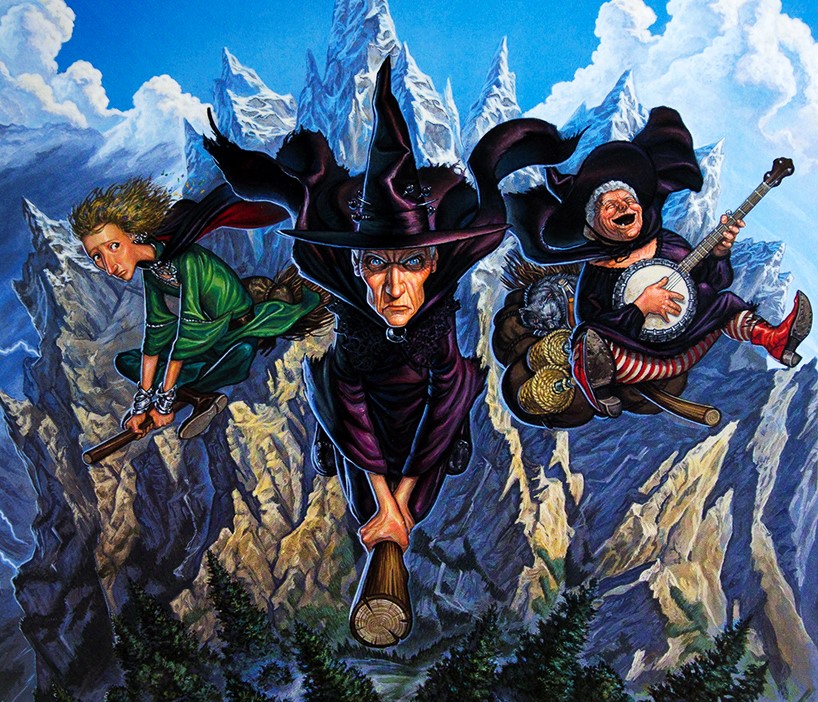
Related imageThe next group of characters your introduced to are the 3 witches.  The adventures of the 3 tend to follow some established plays or stories that have a discworld twist.  You are treated to the tales of Magrat Garlic, Nanny Ogg, and Granny Weatherwax.

Each witch has her own way, and are not of the wicked sort you would think, though they like to play up the mythos for the respect it brings them. Witches in the discworld are able to use magic, but prefer more practical forms of everyday magic.

Namely, they use their heads, apply some logic and common sense to a situation, and question their own thoughts on a matter.  People fear the pointy hat of a witch, but they also know who to see when a child birth is not coming along well, or if animals are getting sick, or if old man Gunther's toe nails require a hammer and chisel to cut down.

Magrat is the youngest and often see's herself playing 3rd fiddle to the other two, much older & skilled women.  She is capable in her own way, and gains a bit of strength for herself by the 3rd book.

Nanny Ogg...well she's interesting.  She's led a very...colorful life.  Nanny Ogg has a massive brood of children, with two of her son's playing parts in some of the books.  She is always the peace maker, and is surprisingly fast for a woman of her girth & age.  She can drink most men under and around a table, has a singing voice that makes people run for cover (literally when its bath time), and she owner to the evilest cat on the discworld - the tomcat Greebo, though to her he's just an old softy (though she will admit that he is quite evil).

Finally there is Granny Weatherwax.  Granny only to those whom have shown respect to her, otherwise she's Mistress Weatherwax.  Considered the greatest witch of the age, and the most powerful, she's a woman who see's to the heart of the matter.  She's very no nonsense, knows a tick when she see's it, and only a good witch by choice (as she could have gone to "the dark" quite easily).  Granny Weatherwax is the main character of the series and has shown up in other books, along with Nanny Ogg.  She has even had a magical duel with one of the former headmasters of the magical school of the discworld and it ended in a draw.  Though witches would never call anyone of their kind the "head witch", Granny Weatherwax is generally treated as it.


Image result for discworld the watchThe next arc of books deals with the city watch of Ankh-Morpork (the largest city of the discworld).  This series follows Samuel Vimes, a police man at the core of his being, but also a drunk - but the type of drunk who's typically two drinks short of actually being sober.  Initially the captain of the cities night watch.  The mundane life he had of he and his men saying "all's well" and avoiding any actual police duty changes when the next main character, Carrot Ironfoundersson.

With the arrival of Carrot, the lives of the watch change from a bunch of lazy guards who just yell the time and tell people it's all well, (even if it's not, but it has to be somewhere), to an impressive bunch of city guards who actually do a decent job.  They even become fairly progressive later, as they are ordered to open their doors to more than just human men (namely dwarves, trolls, and others).  Their cast is ever expanding, though there is a core group of characters.


Next there is the Tiffany Aching series.  Its 5 books long with the last book of the series also being Terry Pratchett's final book.  While it can be difficult to gauge the exact passage of time in the various books, Tiffany's series takes you from the time she is 9 yrs old, to her being an adult.  She's a girl who makes a lot of mistakes, but she is also an impressive young lady.  In each book, Tiffany faces an unusual opponent, something or someone that tests her capabilities.Image result for discworld tiffany aching

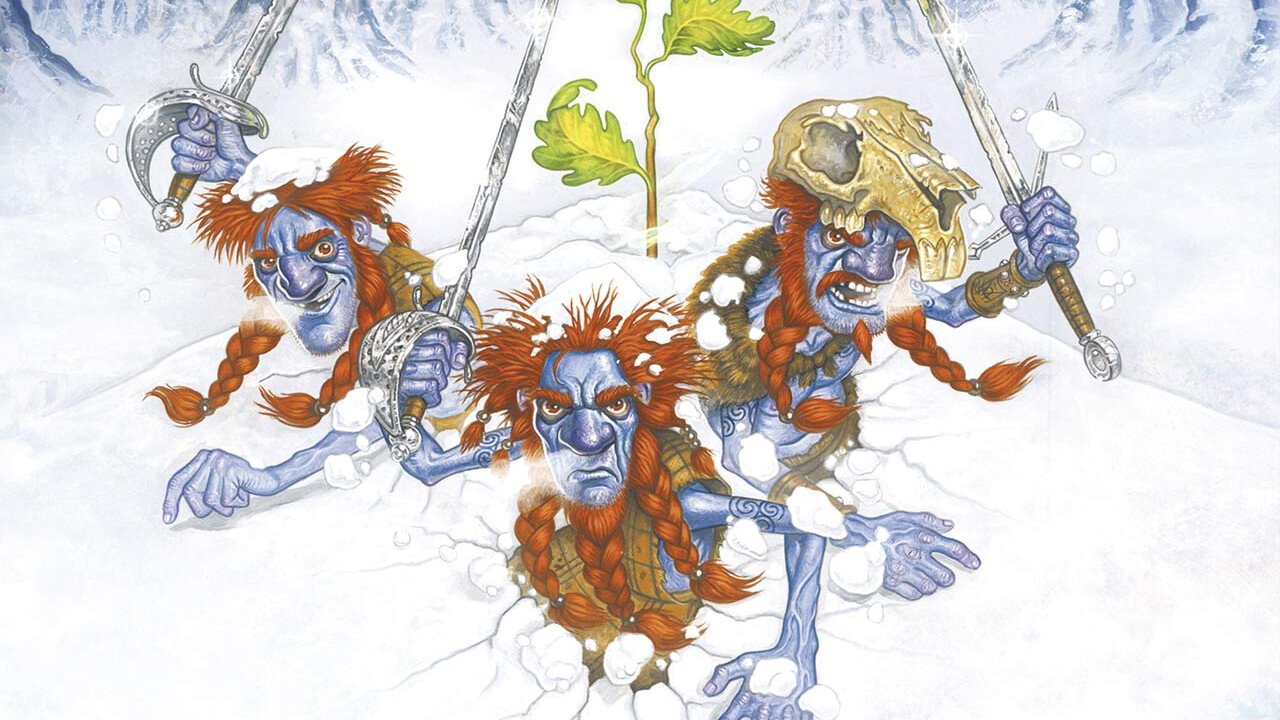
Image result for discworld tiffany achingBut if you think that she's the only character in the story, you'd be wrong.  While certain witches make cameo appearances in the story, it can be said that there are some other small players in the game, who have big personalities.  They're called the Nac Mac Feegle.  Imagine a Scotsman who is 6 inches tall, likes stealing, fighting, and drinking (in any order, or preferably all at once), who has a fear of lawyers, books, and having to explain themselves to hags (witches in their language), and you'd have a Nac Mac Feegle.  On top of being 6 inches tall they all have a mess of red hair, blue skinned in addition to the blue tattoo's the have.  Their swords glow blue when lawyers are around as well.

The series is worth the read just for the appearance of the Wee Free Men (the Nac Mac Feegle).  One of them even joins the city watch of Ankh-MorPork at one time.

The series is meant for younger readers, but is still enjoyable for older readers as well (my wife in particular has been enjoying me reading the books to our kids).


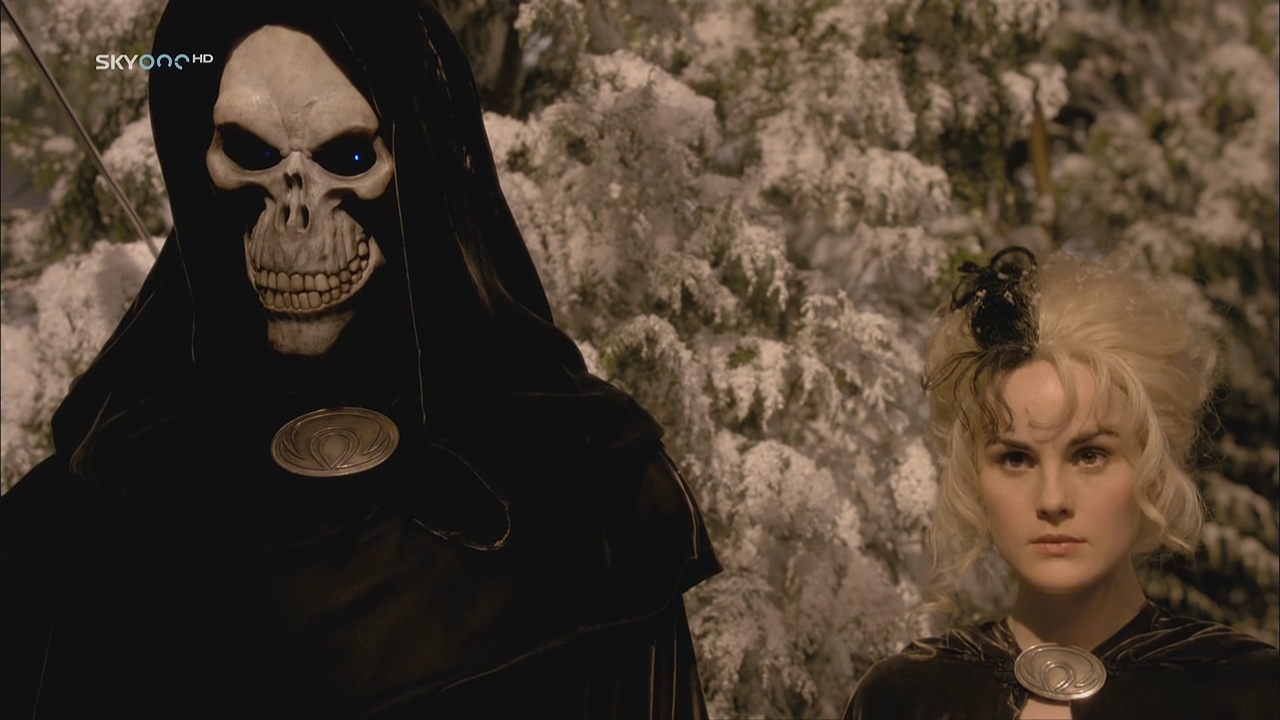
Image result for discworld death familyFinally there is the last player that no one would want to forget.  His name is Death.  Not some guy calling himself that, but the actual anthropomorphic personification of Death, complete with scythe.  Death of the discworld is someone only a few people can see when he goes about his business.  He appears in almost every novel in some way.  He is often irritated that Rincewind ends up in many near death situations but never actually takes that last step.  He has a soft spot for cats, and often finds himself caring just a little too much for mortals.  This has led him to adopting an orphan to be his daughter, keeping a man servant to help mind things around his home, and even taking on an apprentice.

Death is fascinated by mortals, and often suffers from bouts of depression, as he can remember everything like it happened tomorrow.  He has a white horse named Binky, which is a real horse since flaming horses tend to catch things on fire (and then be rather embarrassed about the whole thing), and skeletal horses had difficulty keeping themselves together (since a horse often needs time to sort out just how many legs it has to run with).

But Death isn't alone in his little adventures.  There is also a small matter of his granddaughter.  While her mother was adopted, her father (who was Death's apprentice) became Death for a time - that is he filled in the roll of Death.  This left the two marked, and something was passed on to their daughter, Susan.  Susan is often the main character in stories dealing with Death, though he is a main character as well.  She is first introduced as a young girl in her teens who is completely fearless, and has many powers that Death himself possesses (though not to the same extent).

Related image

Susan and Death are the only supernatural beings that are the major character's of a series in discworld.  Death's antics are often humorous and you feel just a bit sorry for a guy who is always meeting people on the last day of their lives, and who remembers everything that has been and will be.  Susan is very much like the witches you'll read in the other stories.  She's abundantly smart and takes a very practical approach to dealing with problems.  One way of looking at her is as a sort of Goth Mary Poppins.

For example, when a couple of children she is a governess of are being frightened by boogyman in the basement, she arms the children with suitable weapons to deal with the problem head on, or in some cases (when there is an actual monster there) she takes up the dreaded fire poker and deals with the monster herself.

------------------------

--The Discworld as a Game--

It's an interesting fantasy setting, and for those that know - it has been turned into a supplement for the GURPS RPG.  Not exactly the game rules I'd use.

The Discworld is a very story friendly setting, favoring a rich and fun story to tell instead of out right fighting and dungeon delving.  Now it may be 41 books long, but it's an excellent source for an adventure using the Savage Worlds game system.

Now you may need to think up of a different way to handle magic in this game system.  One skill to govern it all is the best path, but you're also going to have to be sure that magic works like it does in the books.  Sure wizards can know a lot of spells, but it takes time to recover from casting spells, and many wizards would rather just stay put than miss out on their four square meals a day.

If your looking for something different for your game sessions - LOOK HERE.

But just remember, the Librarian of Unseen University is an Orangutan, not a monkey - never call him a monkey.  Things tend to go badly for people that do.

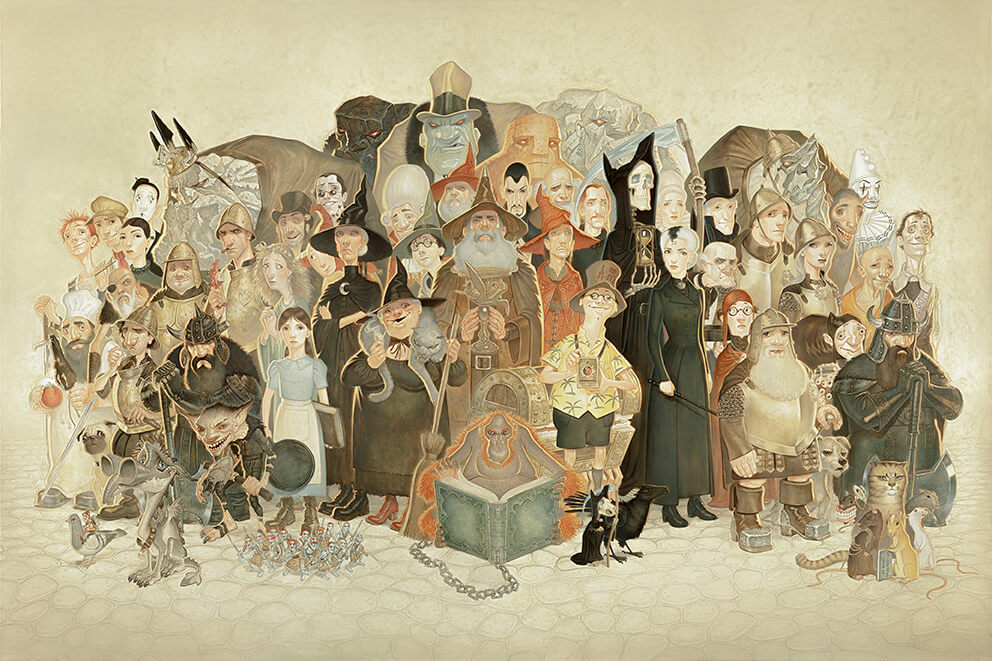
Image result for discworld